Regulations
Digital nomad rentals Italy: the visa, which lease to use, host duties and how to get the home ready
In short
Digital nomads stay from a few weeks to a few months and choose a home for its Wi-Fi and a real desk, which makes them the bridge between short and mid-term rentals. Up to 30 days you use an Italian short let (CIN, Alloggiati Web, tourist tax); beyond that you normally need a contratto transitorio (transitional lease), registered within 30 days, if the tenant’s need fits the local agreement. Non-EU nomads can apply for Italy’s digital nomad and remote worker visa (decree of 29 February 2024), which among other things asks for “suitable documentation” of their accommodation.
 Mid-term rentals without chasing documents and rent€9.99/unit a month until Dec 31
Who are digital nomads and what do they want from a rental?
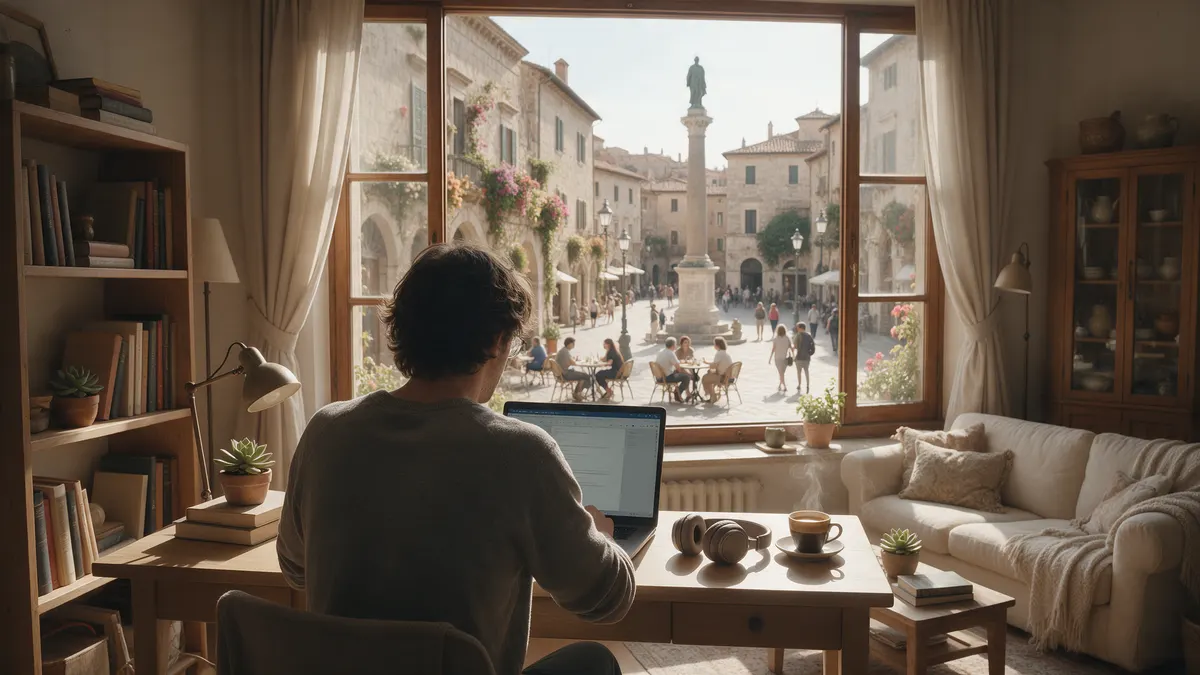
A digital nomad works online and picks a place to live for weeks or months. Italy’s 2024 decree distinguishes two profiles: the digital nomad, who is self-employed, and the remote worker, an employee or contractor of a company that may be based abroad. For an owner the difference is small: both stay longer than tourists, work from the home during office hours and judge a listing on details a tourist ignores.
| Tourist | Digital nomad | |
|---|---|---|
| Typical stay | A few nights | A few weeks to a few months |
| First thing they check | Location, photos, nightly price | Wi-Fi speed, desk, quiet, monthly price |
| How they use the home | Sleep there, spend the day out | Work, cook and do laundry there |
| Italian contract | Short let (locazione breve, up to 30 days) | Short let or transitional lease, depending on length |
| Payments | One payment before arrival | Often monthly, with utilities to agree |
The upside is fewer changeovers, less cleaning and fewer repeated questions; the trade-off is a set-up halfway between hosting and letting. We compare the two models in short-term vs mid-term rental in Italy.
Italy’s digital nomad visa: what it requires
EU citizens don’t need a visa. For everyone else, Italy’s immigration code (Legislative Decree 286/1998, art. 27, paragraph 1, letter q-bis and paragraph 1-sexies) allows entry for digital nomads and remote workers outside the yearly quotas and without a work permit. The details are in the Interior Ministry decree of 29 February 2024, published in the Gazzetta Ufficiale no. 79 of 4 April 2024 and applied from the following day. Article 3 asks applicants to have:
| Requirement | What the decree says |
|---|---|
| Income | A minimum yearly income from lawful sources of at least three times the threshold for exemption from healthcare co-payments |
| Insurance | Health insurance covering medical care and hospital stays in Italy for the whole stay |
| Accommodation | Suitable documentation of the accommodation arrangements |
| Experience | At least six months’ experience in the work they will do as a nomad or remote worker |
| Qualification | Highly qualified work as defined in art. 27-quater of the immigration code, for example a tertiary degree of at least three years or equivalent professional experience |
| Contract | For remote workers, the employment or collaboration contract, or a binding offer |
With the visa, the worker applies for a residence permit at the local Questura within eight working days of arrival. The permit reads “nomade digitale - lavoratore da remoto”, lasts up to one year and can be renewed while the requirements are met; the Questura also issues the Italian tax code, and self-employed nomads must open an Italian VAT number (arts. 4 and 6 of the decree). The decree doesn’t state the income threshold in euros: the consulate handling the application gives the current figure.
Which contract: short let or transitional lease?
| Length | Contract | What you need | More |
|---|---|---|---|
| Up to 30 days | Short let (locazione breve) | No reason and no registration; CIN, Alloggiati Web, ISTAT data and tourist tax | Cedolare secca |
| Over 30 days, up to 18 months | Transitional lease (contratto transitorio) | A temporary need listed in the local agreement, documented; registration within 30 days | Transitional lease guide |
| Over 18 months | Standard lease (4+4 or 3+2) | A transitional lease is no longer allowed | Rental contracts in Italy |
The tricky part is the temporary need (esigenza transitoria). Each town’s territorial agreement lists the situations allowed, usually linked to work, study or training: check that your tenant’s situation is on the list and can be documented, for example with an employment contract or a client letter. A transitional lease that doesn’t follow these rules is converted into a standard 4+4 lease under the 2017 decree, the biggest risk for an owner.
What owners must file for a digital nomad
| Duty | Short let | Transitional lease |
|---|---|---|
| CIN (national ID code) | Yes: displayed outside the building and in every listing | Not for the lease itself; needed if the same home is also used for short or tourist lets |
| Police registration | Alloggiati Web within 24 hours of arrival, after identifying the guest | Registering the lease replaces the “cessione di fabbricato” notice (DL 79/2012, art. 2); for a non-EU tenant, a written notice to the local police authority within 48 hours (art. 7, Legislative Decree 286/1998) |
| Lease registration with the Agenzia delle Entrate | No | Yes, within 30 days, online (RLI) or through an intermediary |
| ISTAT statistics | Yes, to the regional portal | Applies to tourist accommodation: check your region’s rules for transitional leases |
| Tourist tax | Where the town charges it, with a night cap set locally: 10 consecutive nights in Rome, 14 in Milan | Depends on the town’s rules: check them |
| Income tax | Cedolare secca 21% on one home, 26% on others, or IRPEF | Cedolare secca 21% (10% for agreed-rent leases in high-demand towns), or IRPEF |
The art. 7 notice applies to anyone who houses a non-EU national or lets them use a property, and failing to file it carries a fine of €500 to €3,500: ask your Questura how to send it. For short lets you also have to identify guests: see self check-in rules in Italy and the CIN guide.
How to get the home ready for remote work
• Internet: run a speed test and put the measured download and upload speed in the listing
• Plan B: a spare router or another option if the line drops, and a number to call
• Workspace: a real desk, a comfortable chair, daylight and a desk lamp
• Sockets and adapters near the desk
• Noise: mention predictable noise in the listing (traffic, works, church bells)
• A kitchen equipped for daily cooking, not just breakfast
• Washing machine, drying rack or dryer, iron
• Wardrobe and room for long-stay luggage
• Scheduled cleaning and linen changes, for example weekly or fortnightly
• Utilities: included up to a cap, or metered with documented readings, written in the contract
• House rules and local tips: supermarket, gym, coworking spaces, transport
Price by the month, not the night: a long stay earns less per night but fills weeks that would otherwise stay empty. To see how much Italian tourist accommodation is actually used, check our Italy short-term rental data.
Where to find digital nomads and remote workers
- Mid-term platforms such as Uniplaces, HousingAnywhere and Spotahome, built for stays of months with a contract; their bookings reach Maurice automatically.
- Holiday-rental platforms with long-stay options: fine for the first weeks, but beyond 30 days you still need the right Italian contract.
- Companies and coworking spaces in your city looking for homes for staff on assignment.
- Direct bookings from past guests: no commission, but the contract, payments and paperwork are all yours.
For tools, from platforms to management software, see the best mid-term rental software in Italy. If you live abroad, read how to manage an Airbnb in Italy remotely.
Taxes: what changes for you and for your guest
For you, the rules depend on the contract, as in the table above. For your guest there is one more point: anyone who is in Italy for most of the tax year can be treated as an Italian tax resident, even on presence alone (art. 2 of the Italian income tax code, TUIR). It isn’t your obligation, but digital nomads will ask: point them to their own tax adviser rather than answering yourself.
How Maurice handles short and long stays
- Stays up to 30 days: online check-in with documents, automatic Alloggiati Web and ISTAT reporting, tourist tax collected by card;
- stays of months: identity document checks and any documents you ask for, such as a residence permit or an employer letter, online lease signing on request and monthly rent by card, with reminders and late-payment alerts;
- always: 24/7 answers in the guest’s language, with you involved only for repairs and decisions.
All mid-term features are on the mid-term rentals page; recurring payments on payments and rent.
Frequently asked questions
Does Italy have a digital nomad visa?
Yes. It is provided for by art. 27 of Italy’s immigration code (Legislative Decree 286/1998) and regulated by the Interior Ministry decree of 29 February 2024, applied from 5 April 2024. It requires, among other things, an income of at least three times the healthcare co-payment exemption threshold, health insurance, documentation of accommodation and six months’ experience. The permit lasts up to one year and is renewable.
What accommodation document does the visa need?
The decree asks for “suitable documentation of the accommodation arrangements” without naming a specific document: the consulate decides. As an owner you can provide a written confirmation with address, dates and terms or, for stays over 30 days, the signed and registered lease.
Can I rent to a digital nomad with a short let?
Yes, if the stay is 30 days or less: the short-let rules apply, with the CIN, Alloggiati Web, ISTAT reporting and tourist tax. For longer stays you need a suitable contract, usually a transitional lease registered within 30 days. Splitting a long stay into several short lets with the same person doesn’t avoid registration.
Is a transitional lease right for a digital nomad?
Yes, if their situation is one of the temporary needs listed in your town’s territorial agreement, usually linked to work, study or training, and it is documented. The lease lasts up to 18 months and must be registered. If the rules aren’t followed, it can be converted into a standard 4+4 lease, so have it checked by a landlords’ association or a lawyer.
Do I have to notify the police about a non-EU tenant?
Under art. 7 of Italy’s immigration code, anyone who houses a non-EU national or lets them use a property must notify the local police authority in writing within 48 hours; the fine ranges from €500 to €3,500. Registering the lease, instead, replaces the separate “cessione di fabbricato” notice. Ask your Questura how to file.
What do digital nomads look for in an apartment?
Fast, reliable internet, ideally with the measured speed stated in the listing, a proper workspace, quiet, a well-equipped kitchen and a washing machine. A clear monthly price, clear utilities and someone who replies quickly when something breaks matter too.
This article is general information, not legal or tax advice. Rules change and local regulations vary: check with your accountant or a professional before acting.
Sources
- Normattiva — Legislative Decree 286/1998, art. 27 (digital nomads, letter q-bis and para. 1-sexies)
- Gazzetta Ufficiale — Interior Ministry decree of 29 February 2024 on digital nomads and remote workers (GU no. 79, 4 April 2024)
- Normattiva — Legislative Decree 286/1998, art. 27-quater (highly qualified workers)
- Normattiva — Legislative Decree 286/1998, art. 7 (duties of whoever houses a foreign national)
- Normattiva — DL 79/2012, art. 2 (lease registration replaces the cessione di fabbricato notice)
- Normattiva — Law 431/1998, art. 5 (transitional leases)
- Gazzetta Ufficiale — Ministerial Decree of 16 January 2017 (transitional and student leases)
- Agenzia delle Entrate — Short lets and cedolare secca
- Normattiva — TUIR, art. 2 (tax residence)
Matteo Anzidei · Founder of Maurice Assistant
Matteo Anzidei founded Maurice Assistant in Milan to take repetitive work off hosts and property managers: guest messages, check-in, documents, Alloggiati Web and payments. He writes practical guides on short-term rental rules and automation.